Showing posts with label gardening. Show all posts

Friday, April 06, 2007

Horse Chestnuts


I dug up a horse chestnut tree from our front yard because
(a) my wife doesn't like horse chestnuts and;
(b) it was growing out from under the porch and would eventually damage our house

The horse chestnut is actually native to Europe and was a popular tree in the 19th century in Toronto. The horsechestnut was for sale at Dundas and York as early as 1827. Due to a supply glut, George Leslie a local nursery owner, sold many horse chestnuts to the city at a reduced rate, and this accounts for the high number of horse chestnuts on downtown streets. I wonder if the friendly tree on my lawn was a descendant of those early trees...

Saturday, January 06, 2007

Compost


I've managed our family's compost heap for a few years now. It's one of my favorite jobs; part science project, part animal care, part good deed I suppose. The idea that you can take garbage and turn it into clean earth in a few months has a powerful appeal. A couple of years ago we seeded our compost bin with some red worms and the bin has taken off since. As a Christmas present to myself I purchased the Rodale Book of Composting from Lee Valley. Rodale publishes Organic Gardening magazine and this 1992 book is the bible of composting. It covers the basics, and then delves into all sorts of obscure and highly technical details about composting: ideal temperatures, green-brown mixes, alternative techniques such as 'compost in a bag', and even how to set up a farm-scale compost operation. I have no doubt that my efforts are low on the skill scale, but I'm having fun nonetheless.

Friday, December 08, 2006

The apple harvest


The harvest is plentiful (at the supermarket anyhow). Ontario's apple growing region produces fine russet apples. Russets have been popular since Victorian times, when they were called 'leathercoats'. In the Shakespeare play Henry IV, part 2, Davy says to Bardolph, "there's a dish of leathercoats for you"

We've been drinking Bennet's apple cider (944 Garner Rd E Ancaster, ON) this fall. The Straight Dope has an opinionated article on the difference between cider and juice. There is no difference legally speaking between the two; but marketers have seized on cider as a more marketable term.

There's nothing quite like a rich mug of Ontario cider on a cold winter night.

Saturday, November 18, 2006

Last Days of the Garden


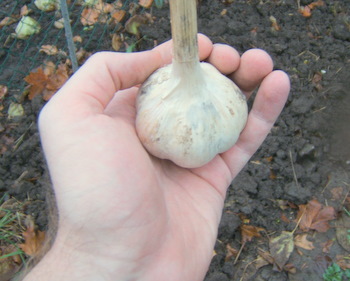
As the days get shorter the garden wilts. The bulbs go into the ground for next year: garlic, daffodils, and snowdrops.

Tuesday, November 14, 2006

Stones II

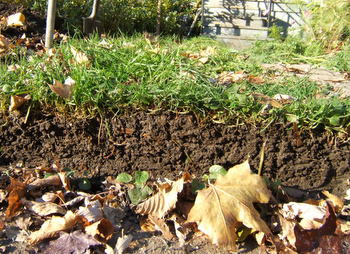
Finally we got the last stones into our front yard and completed the retaining wall.

It was important to us to get a regional material, and the color of stone fits well with the surroundings. The stone is Georgian Bay limestone from Beaver Valley Stone.

Landscaping is a tricky business. In order to prevent frost heaving, the stones are surrounded by gravel wrapped in filter fabric. The gravel allows water to seep away from the stone and the filter fabric keeps dirt particles from mixing with the gravel. In between the gravel and the stones is a layer of limestone fines for precise levelling.


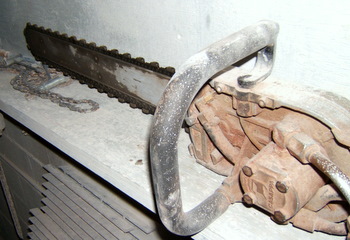
Our friend the stone mason gave us a hand with two stones that required cutting. His diamond-tipped chainsaws cut through limestone like butter


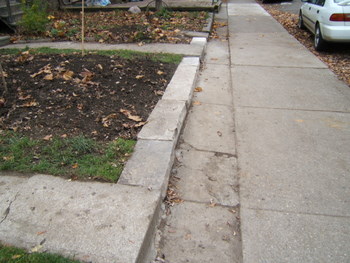
The levelling went well but the stones are not quite in a straight line. They run flush with the sidewalk edge which is not straight. Next time I will follow the string line more closely. But we are very happy with the results; our motto is: perfection is not an option

Monday, November 06, 2006

Stone placing


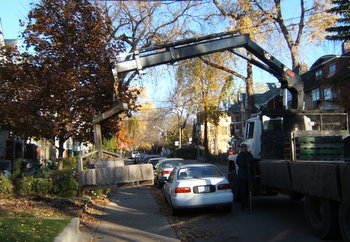
Saturday was stone day for us. At 8:30am the flat bed truck arrived, complete with hydraulic legs and a crane with a ten-foot boom. The crane easily handled the two tonnes of limestone that we ordered, and dropped it in our front yard

We dug a deep trench, taking care not to sever the gas main and cause a blinding explosion. In order to provide proper drainage, it is necessary to line the site with gravel wrapped in filter fabric. The gravel is topped with limestone powder which is used to adjust the level of the stone.

Drop 400 pound rock into place. Measure. Pull 400 pound rock out. Add limestone. Repeat


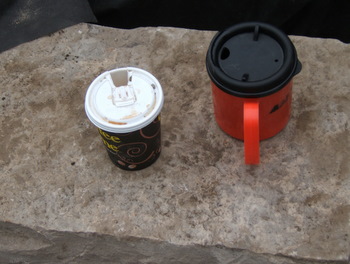
Slurp. ahhh. Coffee helps the job go smoother.

Tuesday, September 26, 2006

Bricks


On the to-do list: re-use these historic bricks from our roof ina tasteful landscape feature. They are too old to use in any critical structure, but perhaps a nice garden wall would do. There's something warm and comforting about a nice brick structure. A connection to the land perhaps. Across the city another project on a much larger scale is reviving interest in Toronto's brick building heritage.

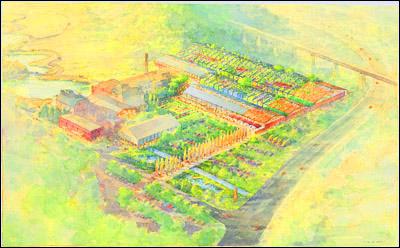
Toronto's Brickworks are under redevelopment. From 1889 to 1984 the The Don Valley Pressed Brick Works Company in the Don Valley producd bricks for a growing city. The Toronto and Region Conservation Authority are the stewards of the upcoming redevelopment which will include a farmer's market, offices, a park, and artist spaces.

With all the nasty environmental issues happening these days it's easy to fall into the trap of bashing our industrial heritage; the companies that built this city. However there is much to celebrate in our past. The Brickworks is one of those sites.

Sunday, September 03, 2006

Tasty Weeds


We have been cultivating a native Ontario plant called Jerusalem Artichoke, a member of the sunflower family. It grows along the eastern seabord from Georgia to Nova Scotia. American Indians called them sun roots and introduced them to early North American settlers. The explorer Samuel de Champlain named them artichokes and sent some of them back to France where they were highly prized.

In modern Ontario, alas this plant is disliked by Ontario farmers as a weed. Agriculture Ontario recommends the herbicide Kilmor® at 1.0 litres per hectare, or Roundup® at 6.5-9.0 L/ha.

I recommend StirFry® with black bean sauce on rice.

Sunday, August 06, 2006

Squash


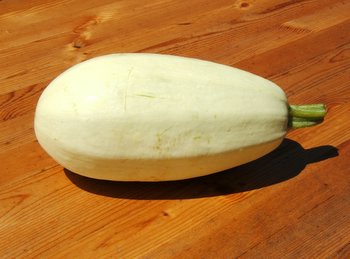
Cooked. The first spaghetti squash from the garden on Sunday. Here it is. Squash is a native North American plant; one of the so-called Three Sisters of agriculture which included also maize and beans. The following recipe from epicurious works well:

Ingredients
  • a 2- to 2 1/2-pound spaghetti squash, halved lengthwise, reserving 1 half for another use
  • 2 tablespoons unsalted butter
  • 1/4 cup finely chopped onions
  • 1 cup thinly sliced mushrooms
  • 2 tablespoons minced fresh parsley leaves
  • 1 tablespoon minced fresh chives
  • 1/4 cup freshly grated Parmesan

Directions
Wrap the squash half in microwave-safe plastic wrap and microwave it, cut side up, at high power (100%) for 10 to 12 minutes, or until it feels soft when pressed. Let the squash stand for 5 minutes.

In a small microwave-safe dish combine the butter, the onion, and the mushroom and microwave the mixture at high power (100%), stirring once, for 5 minutes, or until the mushrooms are tender. Discard the squash seeds, scrape the flesh with a fork into a bowl, and toss it with the mushroom mixture, the parsley, the chives, the Parmesan, and salt and pepper to taste.